Art, Space and the Emotional Experience
For artist and interior architect Alexandra Arata, the relationship between artwork and environment is fundamental to her practice.
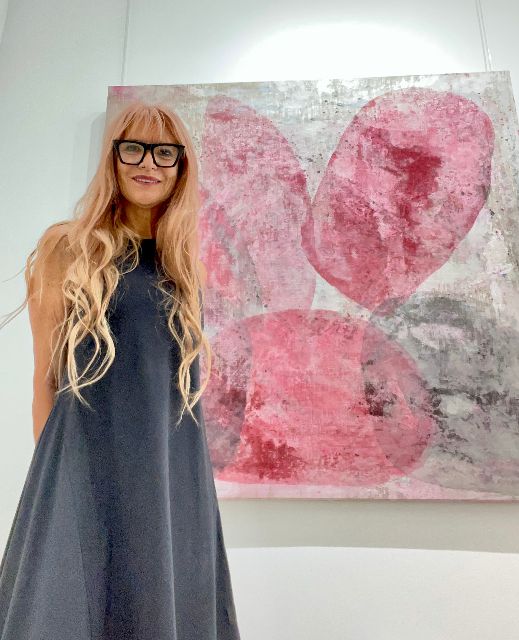
Born in Córdoba, Argentina, and living between Miami and Washington, D.C., Arata explores how color and shape can influence mood, psychology and perception. Her paintings are constructed through layered transparencies, fluid forms and shifting relationships between opacity and color, informed in part by principles of positive psychology.
Her experience also extends directly into the design world. Through Beyond Art+Design, Arata works with commercial and residential clients on art consulting and customized large-scale artwork. Her work is held in private and public collections and appears in environments including the White House building complex, International Monetary Fund, ARUP, CBRE, JBG Smith and NYU Hospitals.
“I explore how shapes and colors can influence our inner world and affect mood, energy, and perception,” says Arata. “Organic forms and layered colors are intuitively balanced to evoke openness, calm, movement, and emotional connection.”
It is a perspective that moves the conversation beyond matching art to an interior. Instead, artwork becomes part of how a space is experienced.
When Architecture Becomes Artistic Language
Anjali Gulati brings an architectural understanding directly into her artistic practice. Trained as an architect in New Delhi and having worked across India, the Middle East and the United States, Gulati applies her understanding of form, balance, composition and the relationship between objects and their surroundings to her art.
Her contemporary works draw upon visual traditions ranging from Indian Gond art to Mexican Alebrijes, African textiles and Australian Aboriginal painting. Gulati translates their organic forms, pattern, rhythm and storytelling into a contemporary visual language.
Texture and materiality are central to the work of Heather Lynn, a Washington, D.C.-based contemporary artist specializing in large-scale residential, commercial and commissioned work. She regularly works with interior designers, art consultants and collectors.
Her work appears in hotels, restaurants, offices and other commercial spaces, while six pieces have been acquired for the permanent collection of the Haegeumgang Museum in Geoje, South Korea. Her Love Soaked 3D sculpture painting collection was also featured in a special exhibition inside the Louvre Museum in Paris and mentioned in The New York Times.
Lynn creates her own texture mediums and has recently incorporated healing crystals, sand, stone and recycled glass, crushing and infusing the materials into her paints to create dimensional surfaces.
Color, Stillness and Connection
Other CHROMA artists offer equally distinct possibilities for interiors.
Maryland artist Nimi Trehan creates abstract paintings intended to be contemplated over time. In her Echoes of Inner Stillness series, negative space functions as a meditative pause, while horizontal lines provide grounding and more energetic brushwork introduces movement. Nature, sky, earth and water become interconnected rather than literal elements.
For Tinu Prakash, connection extends beyond visual composition to the therapeutic potential of art. A contemporary artist with a background in commercial art, graphic design and classical fine-art training, Prakash also serves as an Artist-in-Residence at the Inova Schar Cancer Institute, where she uses live painting in public spaces to share the creative process and facilitate healing.
Her current series explores shared humanity and our interdependence with one another and the natural world. Defined shapes, repetitive forms, bold contrasting colors and curved patterns intertwine across her canvases, visually expressing connection and mutual support.
Sweta Shah: Between Form and Abstraction
Washington, D.C.-area artist Sweta Shah works between abstraction and figuration, using acrylic, charcoal and mixed media to explore memory, identity, belonging and the emotional spaces between people. Born in India and now based in the United States, Shah draws from personal history, cultural memory and the experience of moving between places and identities.
Her intuitive process brings figures, architectural forms and abstract marks together as fragments of experience rather than fixed narratives. Recognizable forms may emerge, dissolve or reassemble through layers of color, gesture and charcoal line, leaving space for viewers to bring their own memories and interpretations to the work.
The Curator as Artist
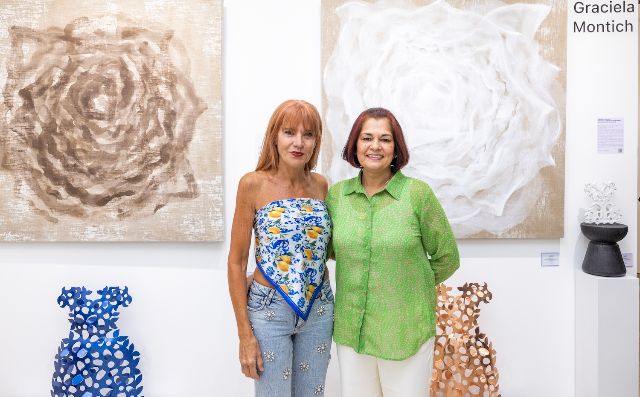
The relationship between artwork and space is particularly relevant to Graciela Montich, who occupies two roles within CHROMA 2026: curator and participating artist.
Born in Córdoba, Argentina, Montich has exhibited internationally in Argentina, Uruguay, Italy, Monte Carlo, France, England and the United States and completed artist residencies in Naples, Italy. Her experience as both artist and curator informs CONSTELLATIONS and the way individual works are considered independently and in relationship to one another within the gallery.
“Each artwork in this exhibition functions like a star within a larger constellation, independent, luminous, and distinctive, yet capable of generating new meanings through its relationship with the others,” says Montich. “A single star is compelling, but a constellation emerges through relationships.”
CHROMA 2026 During Miami Art Week
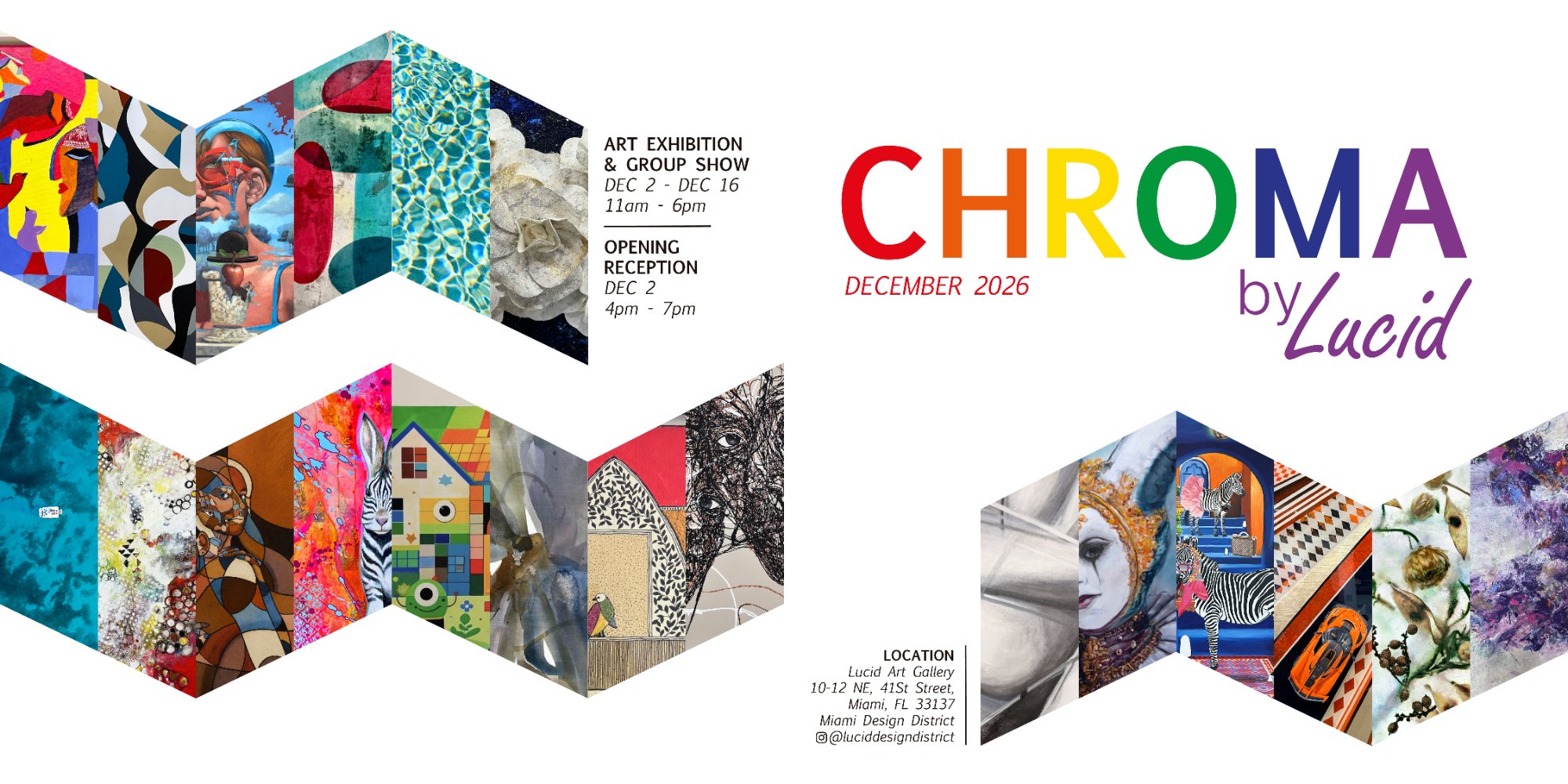
Opening Reception: Wednesday, December 2, 2026 | 4:00 - 7:00 PM
Exhibition: December 2–16, 2026
Location: Lucid Art Gallery | 10 NE 41st Street, Miami, FL 33137
Admission: Free with RSVP
Tickets: Available on Eventbrite beginning October 18
Website: luciddesigndistrict.com
Participating Artists Include:
Alexandra Arata, Aleya Chakravarty, Anjali Gulati, Aparneet Mann, Armando Colls, Bernard Ouellette, Carina Adur, Dagmara Weinberg, Graciela Montich, Heather Lynn, Julieta Abdon, Kevin Fletcher, Maeba Hinrichsen, Nimi Trehan, Olivier Casse, Payal Tak, Robert Frankel, Samantha Chilvers, Shaili Chaudhary, Susan Richman, Sweta Shah, and Tinu Prakash.
About Lucid Design District
Established in 2021 as a studio and exhibition space for founder Payal Tak's personal artwork, Lucid Art Gallery opened to the public during Art Basel Miami 2022. Located at 10 NE 41st Street in the Miami Design District, adjacent to Museum Garage and across from the Institute of Contemporary Art, Miami, the 3,700-square-foot gallery serves as both an exhibition venue and community gathering space for artists, collectors, designers, and cultural events. Featuring eight curated gallery spaces, an expansive reception area, serving kitchen, outdoor installation wall, and flexible indoor and outdoor event areas, Lucid Art Gallery is committed to creating opportunities for artists while inspiring meaningful engagement with contemporary art.
Lucid Art Gallery owner Payal Tak and CHROMA 2026 curator Graciela Montich are available for interviews.